
BharatAds
International
US Emergency Alert Across the Middle East: Be prepared to leave immediately.
Due to fierce Iranian attacks, panic has spread across US military bases in the Middle East and even US embassies in Gulf countries over fears of an attack.
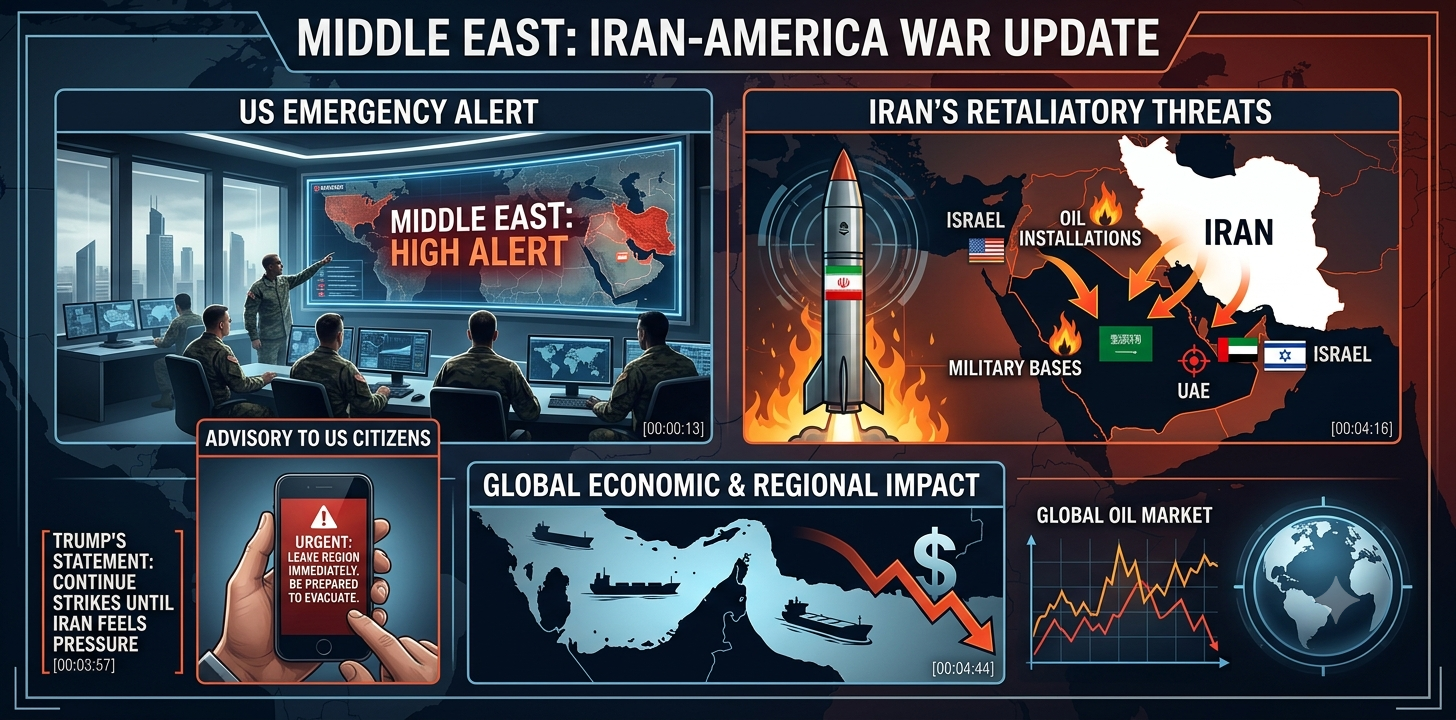
The biggest alert of danger hovers over the skies of the Middle East. US embassies spring into action, and thousands of American citizens receive a single message on their mobile phones:
Be prepared to leave immediately.
This means the situation is no longer just tense; it has turned into a war-like state. Trump is roaring, saying we will continue to attack Iran. On the other hand, Tehran replies that whoever stands with America will also burn.
Ships in Hormuz are in danger, missiles are ready, drones are hovering in the sky, and now, for the first time, America is telling its own citizens: Leave the Middle East or be ready to leave at any moment.
Is war now about to engulf the entire Middle East? Are oil installations going to be the next target? And is the world standing on the brink of an explosion where a single missile could shake the entire global economy?
In this report, we will show you the US embassy's biggest alert, Trump's new warning, Iran's open threat, what America is doing out of fear of Iranian attacks, and the complete sequence of events that has brought the Middle East to high alert.
The situation in the Middle East is becoming more explosive by the hour. The months-long confrontation between America and Iran now seems to be reaching a point where not just soldiers, but ordinary citizens have also come under direct threat. This is why America has taken a step that is usually seen only when the risk of a major military confrontation is extremely serious.
US embassies in Bahrain, Iraq, Israel, Jordan, Kuwait, Lebanon, Oman, Qatar, Saudi Arabia, and the United Arab Emirates have issued special security advisories for their citizens. The message is clear: leave the region if possible, and if you cannot leave, be ready for immediate departure at any time.
This is not just a routine travel advisory. US officials say that the security situation in the Middle East has become extremely volatile. The next move of the Iranian leadership is very difficult to predict, and recent attacks have shown that new areas can be targeted without any warning. This is why even Egypt has now been included in America's list.
America's biggest concern is that if tensions escalate further, air routes could close suddenly. Concerns have been raised about airspace closures, flight cancellations, and borders being affected. Meaning, those who can leave today might get stuck tomorrow. Therefore, US embassies are continuously appealing to their citizens to reconsider travel plans and maintain emergency preparedness.
Meanwhile, the situation in Jordan is reported to be even more sensitive. Recently, missiles were fired there from the direction of US military bases. For this reason, American citizens present there have been advised to stay away from military bases and sensitive areas.
Meanwhile in Israel, people have been asked to identify their nearest bomb shelter and be prepared for any emergency. In Beirut, the capital of Lebanon, the US embassy is already operating under limited conditions.
Now comes the biggest twist in the story. Just one day before this alert, President Donald Trump made a very tough statement. Trump clearly stated that America will continue attacking Iran until Tehran feels the pressure.
Tensions escalated further across the region after this statement, but Iran does not seem in the mood to back down either. Tehran gave an open warning that if America continues its attacks, not only US bases, but also the strategic and energy installations of countries supporting America could come under target.
Concerns grew further after the names of oil installations in Saudi Arabia, the United Arab Emirates, and Israel came up first from Iran's side. Meanwhile, the crisis in the Strait of Hormuz is also deepening. A large portion of the world's oil passes through this route. If military activity increases here or navigation is disrupted, the impact will not remain limited to the Middle East; a major impact could be seen on the global oil market, shipping, and international trade.
The biggest alert of danger hovers over the skies of the Middle East. US embassies spring into action, and thousands of American citizens receive a single message on their mobile phones:
Be prepared to leave immediately.
This means the situation is no longer just tense; it has turned into a war-like state. Trump is roaring, saying we will continue to attack Iran. On the other hand, Tehran replies that whoever stands with America will also burn.
Ships in Hormuz are in danger, missiles are ready, drones are hovering in the sky, and now, for the first time, America is telling its own citizens: Leave the Middle East or be ready to leave at any moment.
Is war now about to engulf the entire Middle East? Are oil installations going to be the next target? And is the world standing on the brink of an explosion where a single missile could shake the entire global economy?
In this report, we will show you the US embassy's biggest alert, Trump's new warning, Iran's open threat, what America is doing out of fear of Iranian attacks, and the complete sequence of events that has brought the Middle East to high alert.
The situation in the Middle East is becoming more explosive by the hour. The months-long confrontation between America and Iran now seems to be reaching a point where not just soldiers, but ordinary citizens have also come under direct threat. This is why America has taken a step that is usually seen only when the risk of a major military confrontation is extremely serious.
US embassies in Bahrain, Iraq, Israel, Jordan, Kuwait, Lebanon, Oman, Qatar, Saudi Arabia, and the United Arab Emirates have issued special security advisories for their citizens. The message is clear: leave the region if possible, and if you cannot leave, be ready for immediate departure at any time.
This is not just a routine travel advisory. US officials say that the security situation in the Middle East has become extremely volatile. The next move of the Iranian leadership is very difficult to predict, and recent attacks have shown that new areas can be targeted without any warning. This is why even Egypt has now been included in America's list.
America's biggest concern is that if tensions escalate further, air routes could close suddenly. Concerns have been raised about airspace closures, flight cancellations, and borders being affected. Meaning, those who can leave today might get stuck tomorrow. Therefore, US embassies are continuously appealing to their citizens to reconsider travel plans and maintain emergency preparedness.
Meanwhile, the situation in Jordan is reported to be even more sensitive. Recently, missiles were fired there from the direction of US military bases. For this reason, American citizens present there have been advised to stay away from military bases and sensitive areas.
Meanwhile in Israel, people have been asked to identify their nearest bomb shelter and be prepared for any emergency. In Beirut, the capital of Lebanon, the US embassy is already operating under limited conditions.
Now comes the biggest twist in the story. Just one day before this alert, President Donald Trump made a very tough statement. Trump clearly stated that America will continue attacking Iran until Tehran feels the pressure.
Tensions escalated further across the region after this statement, but Iran does not seem in the mood to back down either. Tehran gave an open warning that if America continues its attacks, not only US bases, but also the strategic and energy installations of countries supporting America could come under target.
Concerns grew further after the names of oil installations in Saudi Arabia, the United Arab Emirates, and Israel came up first from Iran's side. Meanwhile, the crisis in the Strait of Hormuz is also deepening. A large portion of the world's oil passes through this route. If military activity increases here or navigation is disrupted, the impact will not remain limited to the Middle East; a major impact could be seen on the global oil market, shipping, and international trade.